
Korea lifting device records
Find a lifting device by its exact model, energy and applicator, then read the source within its country and revision.
Oligio generations, surface RF, ultrasound and RF needle applicators retain separate records. Korean permit numbers come from MFDS item records; unmatched ones stay visibly unverified.
Which model are you looking for?
17 model / family records
- Oligio / The OligioWON TECH Co., Ltd.Original Oligio; exact Korean legal model not matchedEnergy / applicatorRadiofrequency (RF)Surface-contact applicatorKorean permitMFDS 제허20-396호 (2020-05-28)
- Oligio XWON TECH Co., Ltd.Oligio X; two verified US clearance eventsEnergy / applicatorRadiofrequency (RF)Surface-contact applicatorKorean permitMFDS 제허23-860호 (2023-08-23)
- Oligio XMWONTECH / 원텍 주식회사Korean marketed hybrid; exact regulatory model not matchedEnergy / applicatorRF + ultrasoundMatch the applicator and IFUKorean permitMFDS 제허23-885호 (2023-09-01)The permit lists the product name oligio xm and the model field Oligio Kiss plus one more. That places both names in one permit record; it does not establish that every configuration is identical.
- Thermage FLXSolta MedicalFLX; not CPTEnergy / applicatorRadiofrequency (RF)Surface-contact applicatorKorean permitMFDS 수허18-245호 (2018-08-21)Thermage CPT has a separate permit (수허13-687호).
- VolnewmerCLASSYS Inc.Volnewmer; exact regional chassis/label pendingEnergy / applicatorRadiofrequency (RF)Surface-contact applicatorKorean permitMFDS 제허22-512호 (2022-08-01)
- 10THERMATentech Inc.FDA model TMSY02Energy / applicatorRadiofrequency (RF)Surface-contact applicatorKorean permitMFDS 제허22-679호 (2022-10-11)The Korean model name (10THERMA-BK) differs from the US model TMSY02.
- DENSITY (2023 record)Jeisys Medical Inc.Original FDA Density record K230663Energy / applicatorRadiofrequency (RF)Surface-contact applicatorKorean permitMFDS 제허23-472호 (2023-04-05)
- DENSITY / DENZA / DENSITY Noir (2025 record)Jeisys Medical IncorporatedThree trade names explicitly listed in FDA K250065; not three independent devicesEnergy / applicatorRadiofrequency (RF)Surface-contact applicatorDocumentsK250065 source, new tabKorean permitKorean permit unverifiedThe domestic DENSITY permit is 제허23-472호 (listed under the 2023 record). The DENSITY Noir permits found (제허23-63호, 제허24-114호) are export-only, and no DENZA permit was found, so the three-name 2025 record is not matched.
- POTENZAJeisys Medical Inc.K231287 update: S handpiece plus three noninvasive tipsEnergy / applicatorRadiofrequency (RF)Match the applicator and IFUSelect a tip to distinguish skin penetration.Korean permitMFDS 제허19-78호 (2019-01-29)Other POTENZA records (제허19-126호, 제허25-497호) are export-only. Tip electrodes are separate permits.
- XERFLutronic CorporationXERF K251327; exact Korea model pendingEnergy / applicatorRadiofrequency (RF)Surface-contact applicatorKorean permitMFDS 제허24-6호 (2024-01-03); MFDS 제허26-350호 (2026-05-11)Two domestic permits carry the XERF name; which one matches a given installed unit needs its label. XERF I and XERF-Overseas permits are export-only.
- Forma / Plus handpiecesInMode Ltd.Forma/Plus as configured on Optimas MAX; separate applicatorsEnergy / applicatorRadiofrequency (RF)Surface-contact applicatorKorean permitKorean permit unverifiedThe InMode RF import permit found (수허19-352호, model name Inmode RF) does not name Forma, so it is not matched.
- Morpheus8 applicator familyInMode Ltd.Morpheus8 applicators K231790; Optimas MAX configuration K251632; Burst/Cool branding is not automatic regulatory equivalenceEnergy / applicatorRadiofrequency (RF)Penetrating electrodesKorean permitKorean permit unverifiedThe InMode RF import permit found (수허19-352호, model name Inmode RF) does not name Morpheus8, so it is not matched.
- Ulthera System / Ultherapy (legacy IFU)Ulthera, Inc.Legacy control-unit IFU, 1015107IFU Rev 05Energy / applicatorUltrasoundSurface-contact applicatorKorean permitMFDS 수허09-1024호 (2009-10-13)One permit lists both Ulthera system and Ulthera Prime.
- Ulthera System PRIMEUlthera, Inc.UC-1 Control Unit PRIME K233996; PRIME Model 2.1 K250418 kept as model revisionEnergy / applicatorUltrasoundSurface-contact applicatorKorean permitMFDS 수허09-1024호 (2009-10-13)One permit lists both Ulthera system and Ulthera Prime.
- ULTRAFORMER IIICLASSYS Inc.ULTRAFORMER III; distinct from MPTEnergy / applicatorUltrasoundSurface-contact applicatorKorean permitMFDS 제허14-1422호 (2014-08-01)The ULTRAFORMER III UF3-C300 permit (제허19-201호) is export-only.
- ULTRAFORMER MPTCLASSYS Inc.MPT = Micro-Pulsed Technology; distinct from IIIEnergy / applicatorUltrasoundSurface-contact applicatorKorean permitMFDS 제허21-831호 (2021-10-06)ULTRAFORMER MPT PLUS has a separate permit (제허26-208호).
- SofWave System / SUPERBSofwave Medical Ltd.SUPERB ultrasound; Pure Impact is a separate electrical muscle-stimulation moduleEnergy / applicatorUltrasoundSurface-contact applicatorKorean permitMFDS 수허21-183호 (2021-07-22)
Research snapshot 2026-10-24; Korean permit numbers matched against MFDS item records on 2026-10-25. Not a list of Korean sales or installations. Inputs stay in browser memory.
How do consoles and tips differ?
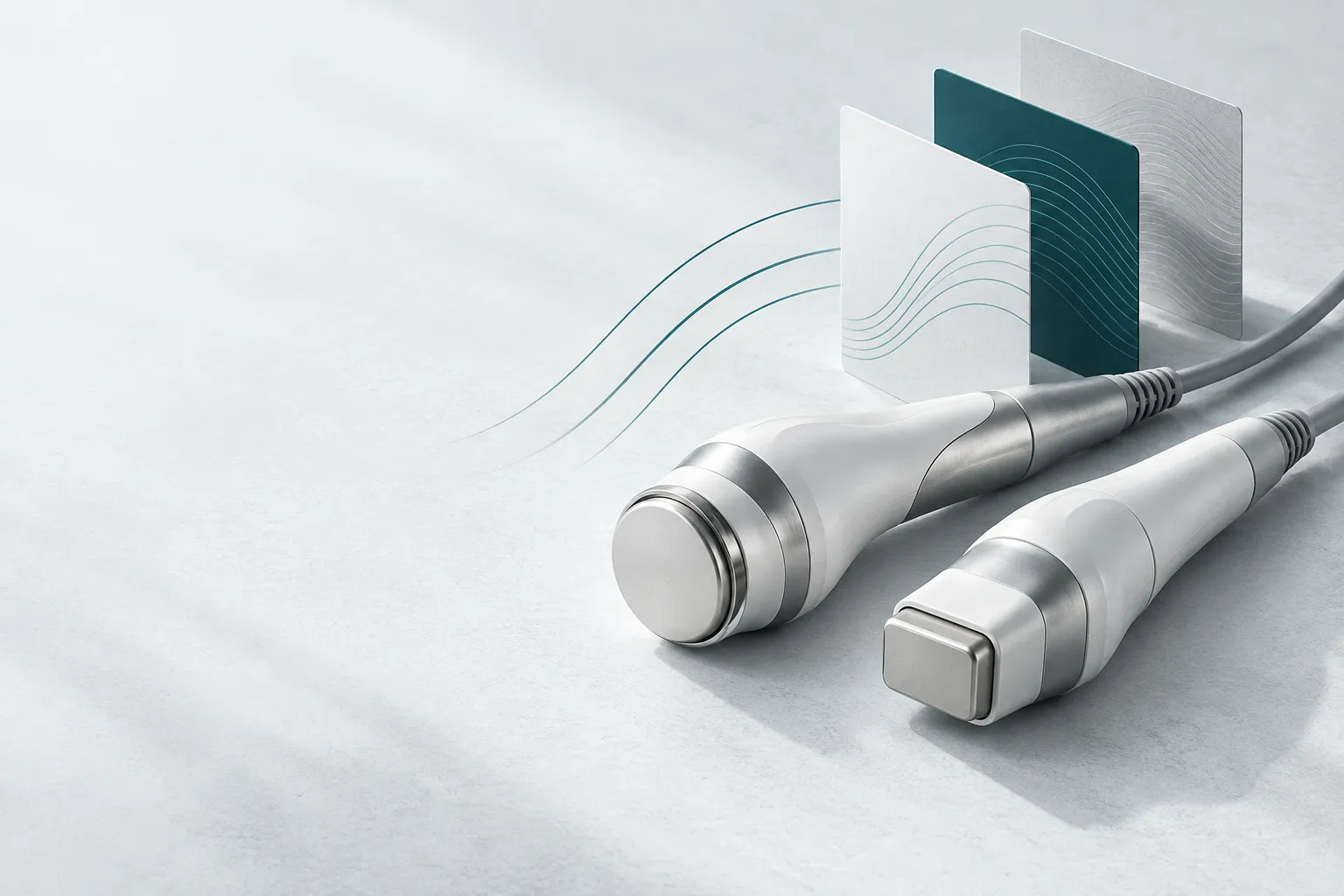
A platform may support both penetrating and surface-contact tips. Keep the model, applicator and source together.
Open model and applicator finderWhat is the document’s scope?
Distinguish US records, Korean MFDS permits and specified-tip recalls. The tool does not choose a treatment.
Open document scope checkerHow are lifting devices grouped by energy and delivery?
Energy family and applicator delivery distinguish surface RF, RF needles, ultrasound and documented combinations.
A shared lifting label does not identify one mechanism. Surface contact and skin penetration are separate fields, and a platform can support both kinds of accessory. The source for each model shows which configuration was actually described.
| Family | Documented example | Distinction |
|---|---|---|
| Surface RF | Oligio X / Thermage FLX | Model-specific indications |
| RF accessories | POTENZA / Morpheus8 | Needle or surface tip |
| Ultrasound | Ulthera / ULTRAFORMER / Sofwave | Focused, imaging and parallel architecture |
Why do lifting device names need a generation?
A shared brand can cover different models, while several names can also appear in one document.
Oligio, X and XM remain separate records. DENSITY, DENZA and DENSITY Noir are read as names listed in one selected US document. Manufacturer naming statements support Shurink relationships without proving every local configuration identical.
What do lifting device source documents establish?
A source can establish identity, technical description or a selected regulatory event within its own scope.
The FDA indications enclosure belongs to the named device and jurisdiction. A manufacturer page has a different role from an independent clinical study. Reading those roles separately prevents a technical specification from becoming a promise of personal benefit.
| Source | Read for | Do not substitute |
|---|---|---|
| Regulator record | Model, country and stated indication | Current Korean permit from US evidence |
| Manufacturer document | Product name and technical claim | Independent clinical comparison |
| Original study | Studied model, endpoint and population | Every model with the same energy |
What is the scope of the lifting device collection?
The 2026-10-24 collection contains 17 model or family records and 18 unique selected US 510(k) documents.
These are collection counts rather than all authorized or installed devices. Current Korean product permits and local labels have not been matched. The missing fields are preserved rather than filled from an overseas identifier.
How do you read device documents?
What else do people ask about Korea lifting device records?
Where should I start with a name on a quote?
Use the model finder, then match the actual handpiece or tip and the source document.
Can I compare RF and ultrasound as one ranking?
Their architectures, indications and studied endpoints need separate evidence.
Why is Korean permit status unverified?
This research has not matched current domestic permit text and exact local labels.
Does the record list recommend a clinic or device?
It supports source identification without booking, referral or personal treatment selection.
Can I read the same content in Korean?
Each static English route has a Korean counterpart under /ko. Server blog posts remain Korean.
Where do these numbers come from?
- K243929 : Oligio X Research access: 2026-10-24. Decision letter identity/date; indications-for-use enclosure and/or summary; device-description/technology sections. Selected sections only, not a full IFU or full dossier.
- K231287 : POTENZA Research access: 2026-10-24. Decision letter identity/date; indications-for-use enclosure and/or summary; device-description/technology sections. Selected sections only, not a full IFU or full dossier.
- Ulthera System Instructions for Use : 1015107IFU Rev 05 Manufacturer first-party identity/technical source, not independent clinical evidence. Research access: 2026-10-24. Sections 2.1 indications and DeepSEE imaging, system identity. Only these selected sections; not the entire 72-page manual.
- 의료기기안심책방 Research access: 2026-10-24. Landing-page text only. Product-level search/permit attachments were not retrieved. No permit number or current Korea indication inferred.
- Medical device item search (의료기기안심책방): lifting device permits Checked 2026-10-25 by product or model name. Permit number, holder, item, product and model name, permit date, validity and export-only flag were read from the item records. Attached technical documents were not read; model lists shown as 'and N more' were not expanded.